Dog Pulling on the Lead and Choking or Coughing: What to Do Today
That honking, gagging sound when your dog hits the end of the lead is horrible to hear. The good news is that you can take most of the pressure off your dog’s throat today, and then fix the pulling itself over the next few weeks.
See a vet straight away if your dog is struggling to breathe, has pale or blue-tinged gums, is breathing very noisily, collapses, or you think something might be stuck in their throat. These are emergencies. PDSA’s advice on coughing in dogs lists when to call your vet.
Why dogs cough or choke when they pull
When the lead is clipped to a collar and your dog pulls, the collar presses on the front of the neck. That’s where the windpipe (trachea) and the larynx sit, just under the skin. Pressure there can make a dog cough, gag or wheeze, and some dogs keep pulling regardless because the thing they want is still ahead of them.
PDSA lists pulling on the lead as one of the common causes of coughing in dogs, and notes that it can often be fixed by using a harness instead of a collar (PDSA).
Neck pressure can also matter beyond the throat. A study of 26 dogs found that pressure in the eye went up significantly when dogs pulled against a collar, but not against a harness. The authors recommend harnesses for dogs with glaucoma, thin corneas or similar eye conditions (Pauli et al., 2006, JAAHA).
Some dogs are more at risk from neck pressure:
- Toy breeds such as Yorkshire Terriers and Chihuahuas, which are prone to tracheal collapse.
- Flat-faced breeds such as Pugs, French Bulldogs and Shih Tzus, which may already have breathing difficulties (BOAS).
- Older dogs, and dogs with heart, airway or eye problems.
If your dog is in one of these groups, a harness for every walk is especially important.
What to change on today’s walk
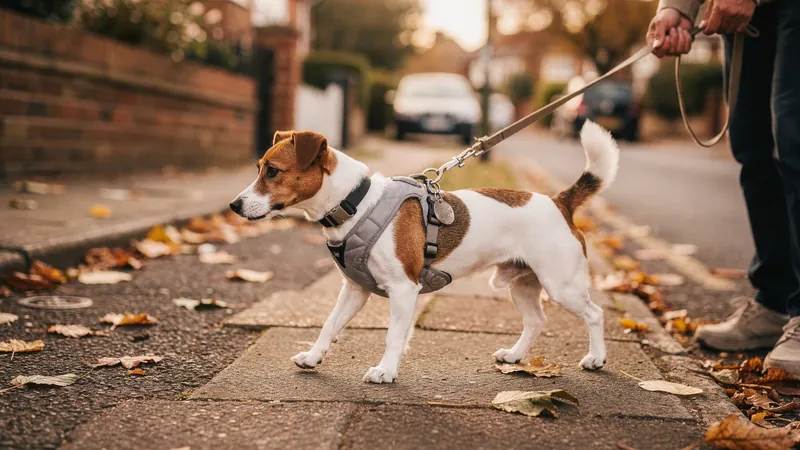
1. Move the lead from the collar to a harness
This is the single biggest change you can make today. Choose a harness that:
- has a Y-shaped front that sits on the breastbone, not straight across the shoulders
- leaves the front legs free to move
- fits snugly enough that you can slide two fingers under the straps, but not so loose your dog can back out of it
We explain the options in harness, head collar or collar? Keep your dog’s collar on for their ID tag: the Control of Dogs Order 1992 requires a dog in a public place to wear a collar with the owner’s name and address on it or on a tag. Just don’t clip the lead to it.
2. Use a longer lead
A short lead goes tight with every step. A lead of about 1.5 to 2 metres gives your dog room to sniff and walk without hitting the end so often. Avoid retractable leads while you’re working on pulling: they put constant tension on the lead, which teaches dogs that pulling is how walks work.
3. Stop when the lead goes tight
If your dog pulls, stop walking and stand still. The moment the lead goes slack (even by a couple of centimetres), walk on. This “be a tree” approach means pulling never gets your dog where they want to go. We go into it in detail in why your dog pulls when excited.
4. Reward the sweet spot
Carry small, tasty treats. Whenever your dog is walking beside you on a loose lead, drop a treat by your leg. You’re showing your dog where the good stuff happens.
5. Pick quieter routes for now
If every walk starts on a busy road with other dogs, cats and smells, your dog will find it very hard not to pull. For a week or two, drive or walk to quieter places, or do short training walks around your street at quiet times.
What not to do
- Don’t jerk the lead or use a slip lead, choke chain or prong collar to “correct” pulling. These work by putting pressure on the neck, which is exactly what we’re trying to avoid, and they can cause pain and fear.
- Don’t keep the lead short and tight to hold your dog back. Constant tension tends to make dogs pull harder against it.
- Don’t tell your dog off for coughing. They’re not doing it on purpose.
When the cough isn’t just about pulling
Pulling on a collar is only one reason dogs cough. Others include kennel cough, heart disease, airway conditions, lungworm and something stuck in the throat. See your vet if your dog:
- coughs when they’re not pulling, or at night
- has a cough that lasts more than a few days
- seems tired, off their food or unwell
- coughs up blood or collapses
A video of the cough on your phone can really help your vet.
Fixing the pulling for good
A harness stops the choking, but it won’t teach your dog to walk nicely on its own. Loose-lead walking is a skill your dog learns through short, regular practice. Start with our free guide, how to stop your dog pulling on the lead, or follow our day-by-day plan, Loose Lead in 21 Days. Both use kind, reward-based methods only.
If your dog lunges, barks or growls at other dogs or people (rather than just pulling towards things), see barking and reactivity and consider a qualified behaviourist. The Animal Behaviour and Training Council (ABTC) keeps UK registers.
Quick recap
- Choking and coughing on walks usually come from collar pressure on the throat.
- Today: harness for the lead, collar for the ID tag, longer lead, stop when it goes tight.
- Never use pressure on the neck to correct pulling.
- See a vet for coughs that happen off the lead, last more than a few days, or come with any other signs of illness.
Frequently asked questions
Is it bad if my dog coughs when pulling on the lead?
An occasional cough when a dog hits the end of a lead on a collar is common, but it's a sign of pressure on the throat. Switch to a well-fitted harness for walks and work on loose-lead walking. If the cough happens off the lead too, lasts more than a few days, or your dog seems unwell, see your vet.
Should I still use a collar?
Your dog should still wear a collar with an ID tag in public in the UK (the Control of Dogs Order 1992 requires it). You just don't need to clip the lead to it. Clip the lead to a harness instead.
Will a harness make my dog pull more?
A harness takes pressure off the neck but doesn't teach your dog where to walk. Many owners find a harness with a front clip gives a little more steering. Either way, the pulling itself improves with training, not kit.
My puppy chokes on the lead. Is that normal?
Puppies often pull because everything is exciting. Use a soft, well-fitted puppy harness from the start, keep walks short and teach loose-lead skills at home first. If your puppy coughs or gags at other times, check with your vet.
Free printable: the 7-day calm-walk tracker
A one-page daily checklist to stick on the fridge. Tick off short practice sessions, note what worked, and see progress at a glance. Free, with occasional emails of practical tips. Unsubscribe any time.
Loose Lead in 21 Days
Everything in our free pulling guide, turned into a day-by-day plan: 21 short sessions with clear “move on when…” checks, printable session cards, a 21-day tracker and troubleshooting for the most common sticking points.
£17 PDF download · 60-day refund, no questions asked
Keep reading
How to Walk a Big, Strong Dog That Pulls (Kindly and Safely)
Being pulled over by a large dog is frightening. Practical, force-free ways to stay safe and in control today, the right kit for big dogs, and how to teach loose-lead walking.
RecallMy Dog Ignores Recall: 9 Reasons and Kind Fixes
Your dog comes back at home but not at the park? Or they've suddenly started ignoring you? Nine common reasons recall breaks down, and what to do about each one.
PullingWhy Your Dog Pulls When Excited (and the 'Be a Tree' Fix)
Does your dog drag you out of the door, towards the park or at the sight of another dog? Why excitement causes pulling, and a calm, step-by-step 'be a tree' routine that helps.