Puppy Jumping Up at Children: A Calm-Greeting Plan
A puppy launching itself at your children can turn a happy family moment into tears in seconds: scratched legs, a toddler knocked over, a puppy getting more and more wound up. It’s very common, and it’s very fixable. The plan has two parts: keep everyone safe now and teach your puppy a better way to say hello.
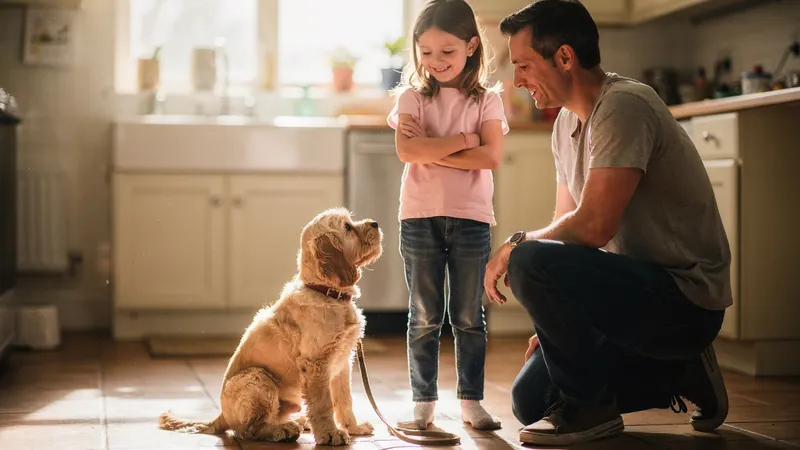
Why puppies jump up at children
- Faces are close. Children’s faces are within easy reach, and puppies like to greet faces.
- Children are exciting. Running, squealing and arm-waving look a lot like play to a puppy.
- It gets a big reaction. Shrieks, pushing and laughing all count as attention, and attention is rewarding.
- Puppies get overtired. Like toddlers, overtired puppies get silly, bitey and bouncy. Puppies need a lot of sleep.
Safety first: supervision and space
Dogs Trust’s advice is clear: always supervise children and dogs together, even your own family dog, and give your dog a quiet space to get away (Dogs Trust: dogs and children). For a bouncy puppy, that means:
- Baby gates and a playpen so the puppy and children can be separated whenever an adult can’t watch closely.
- A quiet den or bed where the puppy can rest and nobody disturbs them.
- Calm times together rather than chase games. Save big play sessions for adult-led games with toys.
- Never leave a toddler and a puppy alone, even for a moment.
- Don’t let young children hold the lead. Even small puppies can pull a child over when excited.
Teach the children to “be a tree”
Children can be brilliant helpers once they know what to do. Teach them this:
- Stop and stand still, like a tree.
- Fold your arms (branches folded in).
- Look at your feet (no eye contact).
- Wait quietly and call an adult if the puppy doesn’t settle.
Dogs Trust’s Be Dog Smart materials teach children a very similar approach: stay calm, cross your arms, turn and look away if a dog jumps up. Practise it as a game when the puppy isn’t around, so it’s easy to remember.
Teach your puppy “four paws on the floor”
The adults do the training. Start when your puppy is calm, not mid-zoomies.
- Reward feet on the floor. Stand near your puppy. The moment all four paws are on the ground, say “yes” and drop a treat on the floor between their feet. Repeat lots of times.
- Keep treats low. Treats on the floor keep your puppy’s head down and make jumping less likely.
- Add a little excitement. Move a bit, talk in a brighter voice, crouch. Reward four paws on the floor.
- Bring in a calm child. With an older child, try this: the child stands still, the adult rewards the puppy for keeping four paws down. Then the child can say a calm hello, stroking the puppy’s chest or side briefly, while the adult drops treats on the floor.
- If the puppy jumps, the child becomes a tree and the adult calmly guides the puppy away with a treat on the floor or pops them behind the gate for a moment to settle.
Keep sessions to a couple of minutes, and stop while your puppy is getting it right.
Jobs for children by age
- Toddlers: no direct training. Keep them separated by a gate or held by an adult. They can watch the puppy have a chew.
- About 4 to 7: be a tree, quiet hellos when an adult says so, drop a treat on the floor with an adult’s help.
- About 8 and over: short, supervised training games (feet on the floor, a sit), scattering treats in the garden for sniffing games, helping fill a puzzle feeder.
These are only rough guides. You know your children and your puppy best.
Prevent the overexcited moments
- After school and teatime are often bounce hour. Pop the puppy in their pen with a long-lasting chew or a stuffed food toy before the children come in.
- Arrivals: let the children come in and settle first, then let the puppy out once everyone is calm.
- Make sure your puppy sleeps. An overtired puppy is a jumpy, bitey puppy.
- Give your puppy outlets: sniffing games, chews and gentle training sessions.
What not to do
- Don’t push, knee or shout at the puppy. It can hurt them, scare them and still be “attention”.
- Don’t allow jumping up sometimes. If Grandad loves a cuddle with paws on his chest, the puppy will keep trying with everyone.
- Don’t let chase games happen. Children running and a puppy chasing quickly leads to nipping.
When to get help
If your puppy’s jumping comes with hard nipping, growling, stiff body language or seems more worried than playful, separate them from the children and speak to a qualified behaviourist (ABTC register). If behaviour changes suddenly, see your vet.
Next steps
- Read our full guide: how to stop your dog jumping up at people.
- Puppy using teeth too? See puppy biting: how long it lasts and how to stop it.
- More puppy help in our puppy hub.
Quick recap
- Puppies jump up at children because it’s exciting and it gets a reaction.
- Supervise always, use gates, and give the puppy a quiet space.
- Children be a tree; adults reward four paws on the floor with treats at floor level.
- Prevent overexcited moments and make sure your puppy gets plenty of sleep.
Frequently asked questions
Why does my puppy only jump up at the children?
Children are at face height for a puppy, move quickly, squeal and often wave their arms, which looks a lot like play. They also tend to react strongly when jumped on, which a puppy can find rewarding.
Should the children say 'down' or push the puppy off?
No. Pushing, shouting and pulling away can all become part of the game. Teach children to stand still, fold their arms and look away, then call an adult.
At what age will my puppy stop jumping up?
There's no set age. Puppies jump up because it works for them. With consistent management and lots of rewards for four paws on the floor, many puppies improve, but it depends on everyone in the house sticking to the same plan.
My puppy nips while jumping up. Is that normal?
Mouthing is normal puppy behaviour, but it can scare and hurt children. Use gates and separate spaces when you can't supervise, and see our puppy biting guide. If nipping seems worried or intense rather than playful, speak to a qualified behaviourist.
Free printable: the 7-day calm-walk tracker
A one-page daily checklist to stick on the fridge. Tick off short practice sessions, note what worked, and see progress at a glance. Free, with occasional emails of practical tips. Unsubscribe any time.
Loose Lead in 21 Days
Does your dog pull on the lead too? Our first Fix Plan tackles that.
Everything in our free pulling guide, turned into a day-by-day plan: 21 short sessions with clear “move on when…” checks, printable session cards, a 21-day tracker and troubleshooting for the most common sticking points.
£17 PDF download · 60-day refund, no questions asked
Keep reading
How to Walk a Big, Strong Dog That Pulls (Kindly and Safely)
Being pulled over by a large dog is frightening. Practical, force-free ways to stay safe and in control today, the right kit for big dogs, and how to teach loose-lead walking.
RecallMy Dog Ignores Recall: 9 Reasons and Kind Fixes
Your dog comes back at home but not at the park? Or they've suddenly started ignoring you? Nine common reasons recall breaks down, and what to do about each one.
PullingWhy Your Dog Pulls When Excited (and the 'Be a Tree' Fix)
Does your dog drag you out of the door, towards the park or at the sight of another dog? Why excitement causes pulling, and a calm, step-by-step 'be a tree' routine that helps.